
Running a Sex Offender Check in Marion County
Two official channels form the core of a Marion County sex offender check. The ALEA Community Information Center supplies the public Alabama Sex Offender Registry search. The Marion County Sheriff's Office Sex Offender Division handles local registration and address reporting. ALEA maintains the statewide public data, while local law enforcement sends current registration details, a photograph, and fingerprints to the state unit.
Start with the state search for a broad result, then call the Marion County office when a listed address seems wrong, too close to a restricted site, or tied to possible noncompliance. The state registry is reported as updating daily from local submissions, yet that does not make every field a live fact. A person may have moved but not yet reported, a local report may still be under review, or a record may be lawfully omitted from public display.
The sheriff's Sex Offender Division page identifies the local unit that receives Marion County registration information.
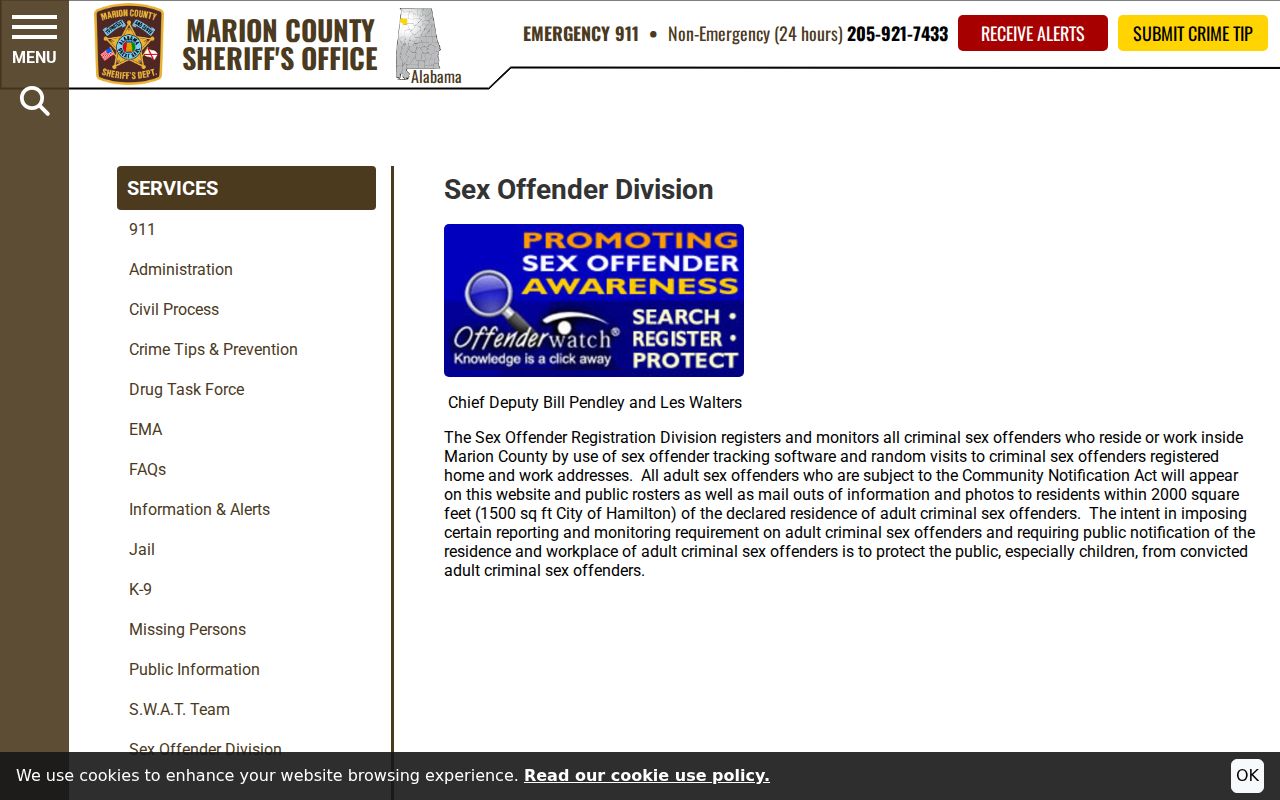
That local route matters most when a public profile raises a specific address or compliance concern within Marion County.
Marion County Registry Updates Start Locally
A Marion County registry record moves from the local office to ALEA. Adults report in person during their birth month and again every three months. The acknowledgment process also calls for in-person reporting within three business days when a residence changes or when work, volunteer activity, or school creates a new reporting location. Local staff gather and forward the current facts; ALEA then places the public portions into the state system.
For Marion County, use the current sheriff contact at 842 Industrial Drive, Hamilton, AL 35570, or call 205-921-7433. An older sheriff page conflicts on the address, so confirm the destination before making a trip. The ALEA Sex Offender Registry Unit can be reached at 334-676-7898 or sexoffenderunit@alea.gov for state-level registry questions. These channels serve different jobs: the sheriff handles local registration and reported compliance issues, while ALEA maintains statewide publication.
Note: A public profile can trail a newly reported change while local staff and ALEA process and publish the updated Marion County information.
Searching the Alabama Sex Offender Registry
Alabama law requires public search capability by name, city or town, county, ZIP code, and geographic radius. The exact vendor interface could not be inspected because it returned a JavaScript access challenge. That means button labels, radius choices, map controls, required fields, page size, and alert tools cannot be stated as verified. Use the available controls without assuming that an empty field or one search mode covers all Marion County entries.
- Open the ALEA Community Information Center and read its conditions of use.
- Choose Marion County when that filter is available, or search a Marion County city, ZIP code, address radius, or known name.
- Compare possible matches by photo, physical description, address, aliases, and offense information rather than relying on the name alone.
- Open the full public profile, note its status, and contact the Marion County Sheriff's Office about a suspected address or compliance problem.
The verified search capabilities come from Ala. Code § 15-20A-8(e), not from guessed screen controls.
| Field Label | Type | Required | Verified Basis |
|---|---|---|---|
| Name | Text or interface unknown | Unspecified | Required search capability |
| City or Town | Text or select unknown | Unspecified | Required search capability |
| County | Text or select unknown | Unspecified | Choose Marion when available |
| ZIP Code | Text | Unspecified | Required search capability |
| Geographic Radius | Address and radius controls unknown | Unspecified | Exact distances not verified |
The ALEA Community Information Center is the official state entry point shown here.
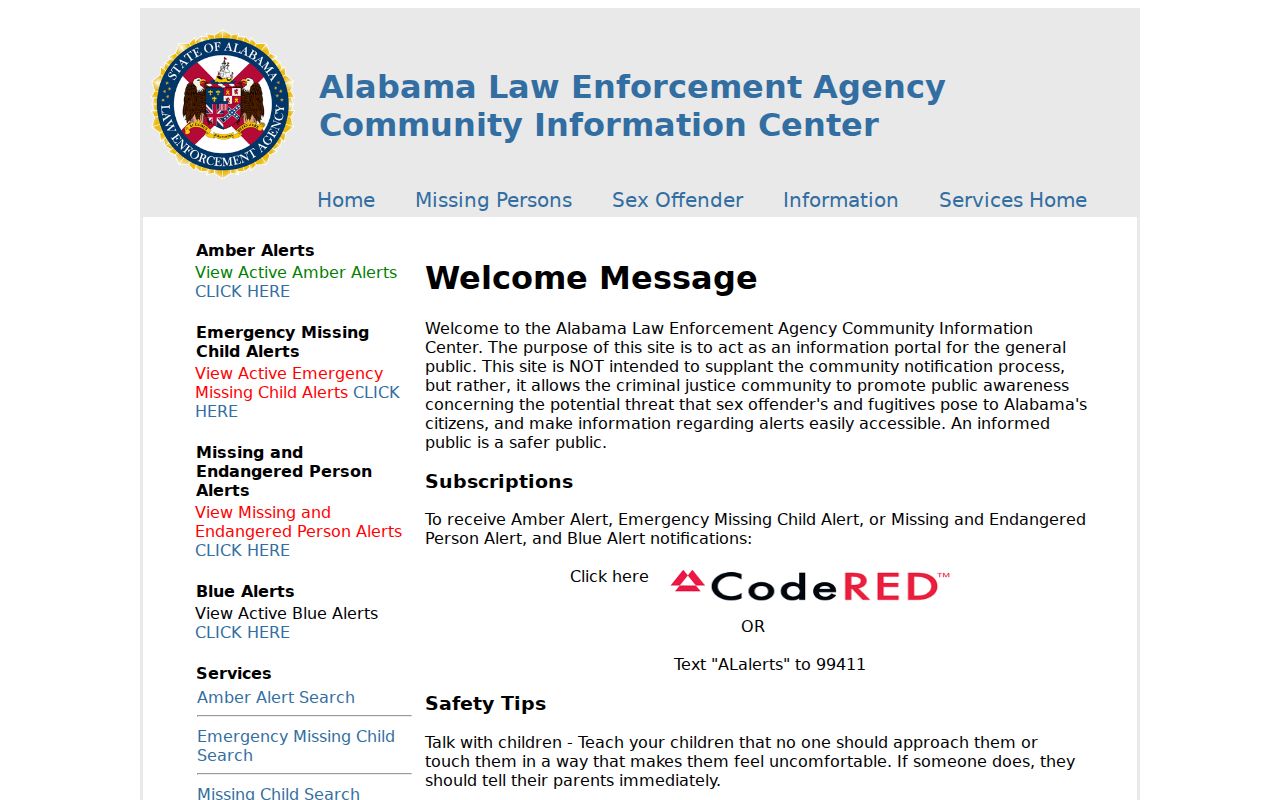
Use its public registry controls as they appear, and do not treat a missing Marion County result as proof that no qualifying history exists.
A Blank Marion County Registry Search
A blank Marion County registry search is not a clean bill of history. Public omission may result from juvenile status unless the person is classified as high risk, Youthful Offender limits, pending due process for some out-of-state or federal matters, or an offense outside Ala. Code § 15-20A-5. ALEA also explains that a first conviction for Indecent Exposure or Sexual Misconduct is not posted. Those rules make the public registry narrower than a complete criminal history.
The registry also excludes nonconviction arrest history, Social Security numbers, victim identities, travel and immigration document numbers, email or instant-message identifiers, and internet service providers. A Marion County search therefore answers whether ALEA currently publishes a matching registry profile. It does not answer whether the person has ever been arrested, whether every court record is public, or whether another state holds a record.
The ALEA registry information page explains the state's update process and key publication limits.
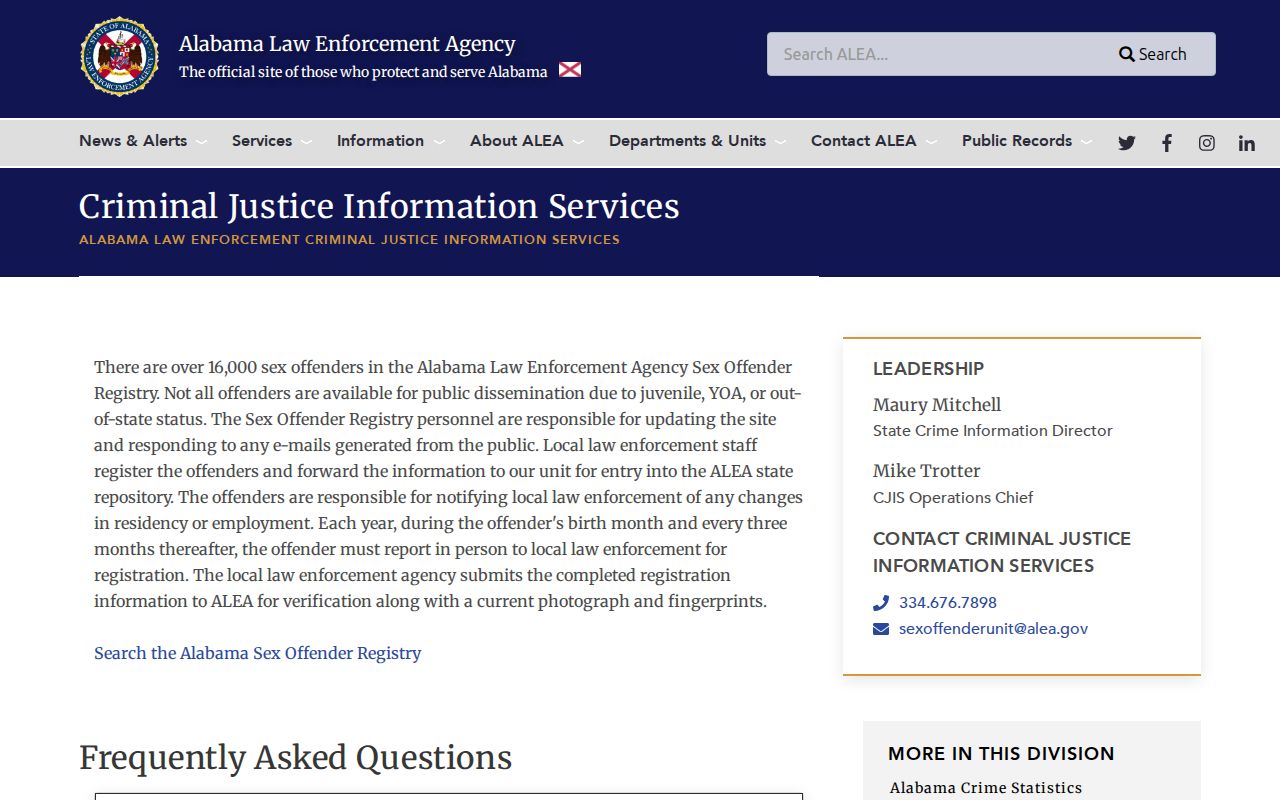
These limits are why a result must be read as a public notification record, not as a full account of one person's past.
What a Registry Profile Shows
A public Alabama profile combines identity, location, offense, and status facts that support a careful match. Some fields may be absent when they were not reported or cannot lawfully be shown. Read the whole profile before drawing a conclusion about a Marion County result.
| Name and Aliases | Published name plus reported nicknames and other qualifying names. |
|---|---|
| Photo and Description | Photograph and physical traits used to distinguish people with similar names. |
| Reported Locations | Residence, school, and employer addresses when subject to public release. |
| Vehicles | Reported plates and descriptions for vehicles, aircraft, or watercraft. |
| Offense Information | Qualifying sex-offense history and the text of the criminal provision. |
| Registration Status | Current public status, including an absconded designation when applicable. |
No public adult risk score appears in these fields. ALEA has not assessed each adult's individual chance of reoffending or current dangerousness. Use the facts for awareness and sound safety planning, not to invent a risk rank that Alabama does not publish.
Cross-State Marion County Offender Searches
A local or Alabama-only check can miss a record published by another jurisdiction. The U.S. Department of Justice's National Sex Offender Public Website federates searches across participating states, territories, and Tribal systems. It is the better next step when a person recently moved, a known address lies near a state line, or the relevant location is uncertain.
NSOPW does not replace the Marion County office. A national result points back to the jurisdiction that supplied it, and local law enforcement is still the right contact for a suspected wrong address in Marion County. Search spelling variants and known aliases when the public controls allow them. Then compare the source jurisdiction, photo, address, and offense details instead of assuming that a shared name identifies the same person.
The national registry search provides the cross-jurisdiction layer shown below.
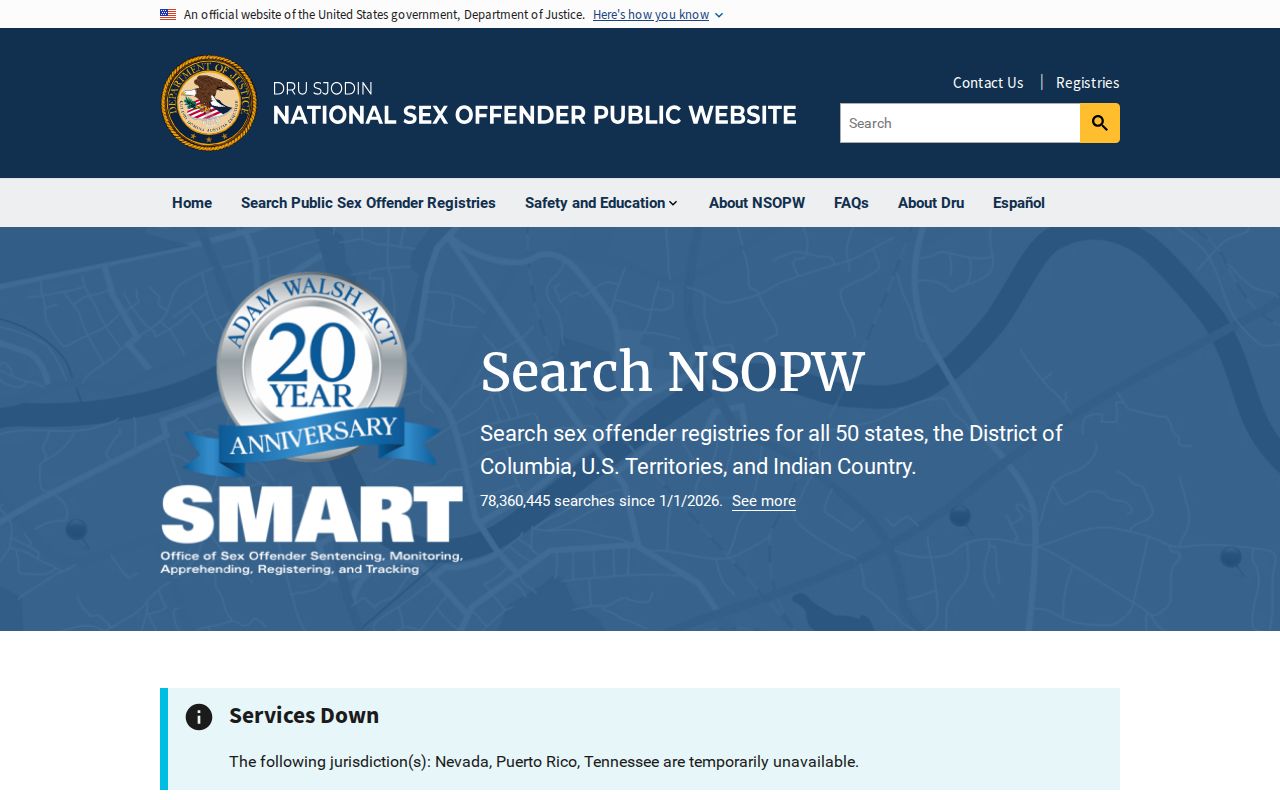
Its value is reach across borders; Marion County reporting and address questions still return to the sheriff's local registration office.
Registration Requirements and Levels in Alabama
Alabama does not publish the familiar three-tier adult risk scale used in some states. Federal SMART review instead describes one adult registration category: qualifying adult registrants report quarterly for life. Juvenile and Youthful Offender matters follow different duration and publicity rules, so they should not be treated as adult tiers.
| Registration Category | Duration | Verification and Visibility |
|---|---|---|
| Qualifying adult | Life | Reports in birth month and every three months; public profile when law permits. |
| Specified aggravated juvenile adjudication | May be lifetime | Publicity depends on state law and court rules. |
| Other juvenile or youthful registration | Generally ten years | Publicity may be limited by juvenile or Youthful Offender protections. |
A label or duration is not a risk forecast. For adult Marion County registrants, quarterly in-person reporting and prompt change reporting are compliance duties, not a public score. A public omission can also result from lawful restrictions rather than a database fault.
Marion County's 2,000-Foot Registry Rule
Alabama's general residency rule uses a 2,000-foot distance measured property line to property line from schools, child-care facilities, resident camps, and specified victims, subject to statutory exceptions. A straight-line guess from a door or road is not the stated method. When a Marion County address appears too close, report the concern to the sheriff rather than confronting the resident or trying to make a legal measurement from a map.
Community notice has its own reach. For a county in Marion County's size category, Ala. Code § 15-20A-21 generally calls for sheriff notice to residences within 2,000 feet and to schools and child-care facilities within three miles. The portal adds a public search channel, but it does not replace local notice. Research did not verify registry alerts in the Marion sheriff safety app, so readers should not rely on the app for that feature.
Note: Statutory exceptions and property boundaries can affect a distance question, so a map estimate alone does not establish a Marion County violation.
Report Marion County Registry Noncompliance
Send a suspected wrong address, too-close address, missed verification, or other noncompliance concern to the Marion County Sheriff's Office at 205-921-7433. Give the profile name, the address shown, the location observed, and the reason for the concern. Do not conduct surveillance, enter private property, or confront anyone. The local office can compare the report with registration facts that are not all shown to the public.
If a registrant stops reporting, the matter can move from missed verification to local investigation, notice to ALEA or the U.S. Marshals, a warrant, and an absconded status on the public profile. Those steps require official review. A member of the public should report facts, preserve personal safety, and allow law enforcement to decide whether the evidence supports enforcement or a profile update.
Lawful Use and Community Notification
Registry information serves public awareness and personal or family safety planning. It does not grant a right to threaten a registrant, target a household, damage property, or organize vigilantism. Alabama's registry warning also matters when reading a profile: ALEA has not made an individual adult risk assessment, so status and offense facts should not be turned into claims the profile does not support.
Misuse is a crime: Ala. Code § 15-20A-8 prohibits using registry information to injure, harass, or commit a criminal act against a registrant or another person.
Use official details to plan reasonable precautions and contact the sheriff when a Marion County fact appears wrong. Community notice and registry access work best when reports are specific, calm, and routed to the office that can verify them.